PCI compliance cost: where the money goes
The cost drivers, what is one-off versus recurring, and an honest view of where the 6.4.3 and 11.6.1 line item sits relative to everything else.
TL;DR
PCI compliance cost
SCOPE DRIVES EVERYTHING
Cost tracks how much of your environment touches card data. Reducing scope is the single biggest lever and it is an architecture decision, not a procurement one.
ASSESSMENT IS ONLY PART OF IT
The QSA fee is visible. Remediation, tooling, staff time and the annual rhythm usually cost more.
CLIENT-SIDE IS A SMALL LINE
6.4.3 and 11.6.1 tooling is among the cheaper items, and it is new, so it often appears as an unbudgeted addition rather than a large one.
Short on time? We publish our own price, which is the only figure on this page we can state with certainty. See it.
How much does PCI compliance cost?
PCI compliance costs range from a few hundred dollars a year for a small SAQ A merchant to well into six figures for a Level 1 merchant requiring a full Report on Compliance with remediation. The range is that wide because the cost is driven by scope rather than by the standard. A merchant who has fully outsourced payment handling has a short questionnaire and little to remediate. A merchant storing card data across several systems has an assessment that touches everything. Anyone quoting a single number for PCI compliance is describing their own situation rather than yours.
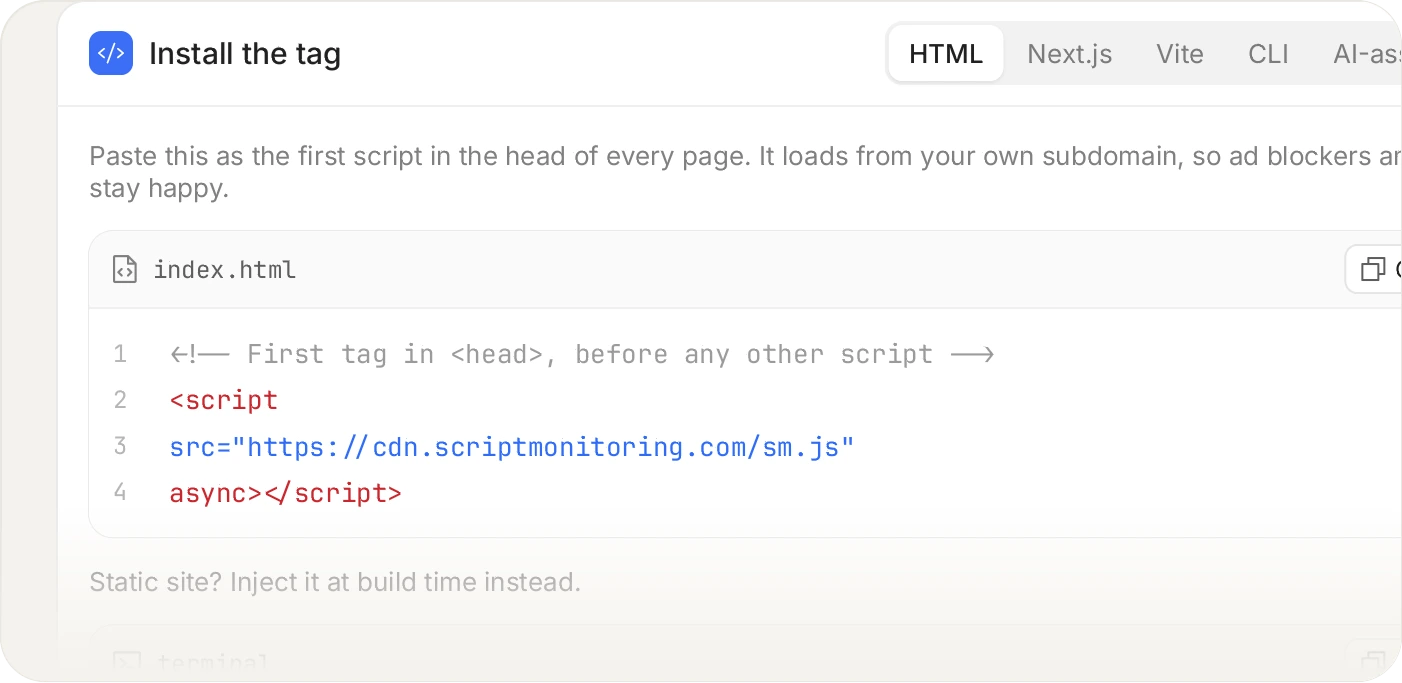
One first-party tag, added the way your stack already ships code. No DNS change and no CDN change, because your traffic is never routed anywhere.
What actually drives the cost
1
Scope
How many systems store, process or transmit card data, and how well segmented they are. This dominates every other factor.
2
Merchant level
Set by annual transaction volume. Level 1 generally means a QSA assessment and a Report on Compliance rather than a self-assessment.
3
Validation route
A self-assessment questionnaire costs staff time. A Report on Compliance costs a QSA engagement on top.
4
Remediation
Usually the largest and least predictable item, because it depends on the gap between where you are and where the standard expects you to be.
5
Tooling
Scanning, logging, monitoring and the client-side controls. Recurring.
6
Staff time
Consistently underestimated. Evidence collection, questionnaire completion and coordinating an assessment is real work for real people.
One-off versus recurring
Worth separating, because budgeting for a recurring cost as if it were one-off is how programmes get into trouble in year two.
Cost
Type
Note
Initial gap analysis
One-off
Sometimes bundled into a first assessment
Remediation projects
Mostly one-off
Segmentation, encryption, architecture changes
QSA assessment
Recurring, annual
Where a RoC is required
ASV scanning
Recurring, quarterly
Where external scanning applies
Security tooling
Recurring
Including 6.4.3 and 11.6.1 monitoring
Staff time
Recurring
The most underestimated line in most budgets
Our pricing is published, which is unusual in this category.
Where the client-side line item lands
The 6.4.3 and 11.6.1 requirements are new enough that they frequently appear as an unbudgeted addition to an existing programme, which makes them feel more significant than the amount involved.
Most of this category prices by quote, so comparison is difficult. We publish ours: free at 1,000 page views a month, $99/month at 100,000 payment-page views, $499/month at 500,000, $799/month at 1,000,000, and $0.0013 per page view in overage. Because scope is your payment pages rather than your whole site, the relevant number is usually far smaller than total traffic.
Reducing the cost honestly
Scope reduction is the only large lever. Moving card entry to a provider-hosted page or iframe removes systems from the cardholder data environment and can move you to a shorter questionnaire, and it is worth more than any tooling decision.
Beyond that: remove scripts you cannot justify, which reduces both risk and the 6.4.3 workload; keep evidence continuously rather than reconstructing it annually; and get your SAQ classification right, because the difference between SAQ A and SAQ A-EP is substantial.
Sources and methodology
PCI DSS requirement text is quoted from PCI DSS v4.0.1 (June 2024), published by the PCI Security Standards Council, which is the current version at the time of writing. Requirements 6.4.3 and 11.6.1 became mandatory on 31 March 2025. Where we describe a competitor, we describe publicly available information and say so when something should be verified with the vendor. We publish this product and that is a bias worth knowing about while you read.
ASK AN AI
Don’t just take our word for it
Ask your assistant what to look for in a tool for PCI DSS 6.4.3 and 11.6.1.
Frequently asked questions
It varies with scope, and the honest answer is that we are not the right source for a number. It depends on the size of your cardholder data environment, the number of locations and systems, and how much remediation is needed. Get two or three quotes, because they differ widely for the same scope.
Yes, usually substantially. Outsourcing card handling removes systems from scope, which can move you to a shorter questionnaire and reduce the assessment surface. It does not remove your obligations entirely, and the client-side requirements are a good example of one that remains.
Ours is published: free for 1,000 page views a month, from $99/month for 100,000 payment-page views, $499/month at 500,000, $799/month at 1,000,000, overage at $0.0013 per page view. Most vendors in this category do not publish figures, so comparing requires a sales cycle.
Yes, though not directly from the PCI Council. Fines are levied by the card brands and passed to you through your acquirer. Amounts are contractual and vary. The larger exposure is usually after a breach, where being found non-compliant affects liability, card reissuance costs and your validation level going forward.
Yes, where external vulnerability scanning applies to your validation route, and it must be performed by an Approved Scanning Vendor. Whether it applies depends on your SAQ type, so check which questionnaire you are completing.
Yes, if your merchant level and acquirer permit it. Self-assessment removes the QSA fee and replaces it with staff time, which is not free. It also places the judgement on you, so for a complex environment an assessor is often worth the cost.
More than you think, and this is the line most often missed. Evidence collection, questionnaire completion, coordinating across teams and chasing script owners for justifications all take real time from people who have other jobs.
Yes, and it is the only lever that changes the order of magnitude rather than the margin. Every system removed from the cardholder data environment is a system that does not need assessing, hardening, logging or monitoring.
Sometimes, and the thing to check is whether it produces what your assessor will accept. A scanner is usually cheaper than session-level monitoring, and some assessors do not accept a control that cannot block. Buying something your assessor rejects is the expensive outcome.
Often yes, and they are not substitutes. A GRC platform tracks evidence across all twelve requirement families. A client-side tool produces the actual technical control for two of them. See PCI compliance software for the distinction.
Yes, it is allowed. PCI DSS names the control, not a product, and the techniques can be run by you or by a third party. A workable setup is a strict CSP with reporting, SRI on static scripts, an inventory with a written justification per script, and a scheduled headless browser such as Playwright or Puppeteer that loads each payment page at least weekly, records every script hash and security header, compares them with an approved baseline and alerts a named person. The cost is upkeep and evidence: scripts injected by a tag manager, or only for some visitors, are easy to miss from one crawler, and you have to keep the records an assessor will ask for.
Related articles
PCI DSS
PCI DSS compliance: a practical guide for 2026
What the standard covers, what changed in v4.0.1, and where the two client-side requirements fit.
PCI DSS
PCI DSS 4.0.1 requirements: what changed and when
The changes that matter, the dates that already passed, and the two requirements most teams missed.
PCI DSS
How to comply with PCI DSS 6.4.3 and 11.6.1
A step-by-step method, from defining payment-page scope to handing an assessor the evidence.
PCI DSS
SAQ A and the script requirements: who is exempt
The January 2025 carve-out is narrower than most people think. Here is what it actually says.
See every script on your own checkout.
Install the tag, mark your payment pages, and watch the inventory fill in. Free forever on 1,000 page views a month, no credit card.
Free forever plan. No credit card.