PCI DSS compliance: a practical guide
What the standard covers, which validation route applies to you, what changed in v4.0.1, and where the two client-side requirements fit.
TL;DR
PCI DSS compliance
WHAT IT IS
A security standard for any organisation that stores, processes or transmits cardholder data, maintained by the PCI Security Standards Council and enforced by the card brands and acquirers.
THE CURRENT VERSION
v4.0.1, published June 2024. The future-dated requirements from v4.0 became mandatory on 31 March 2025, including the two client-side ones.
THE PART MOST TEAMS MISSED
6.4.3 and 11.6.1 cover scripts on payment pages. They are the newest requirements and the ones least likely to be already covered by an existing control.
Short on time? If you already have a PCI programme and want the new part, skip to the client-side requirements.
What is PCI DSS compliance?
PCI DSS compliance means meeting the Payment Card Industry Data Security Standard, a set of technical and operational requirements for any organisation that stores, processes or transmits cardholder data. It is not a law. It is a contractual obligation enforced through your acquirer and the card brands, which in practice makes it as binding as a law and rather faster to act on. The standard is maintained by the PCI Security Standards Council, and the current version is v4.0.1, published in June 2024. Validation happens either through a formal assessment by a Qualified Security Assessor producing a Report on Compliance, or through a Self-Assessment Questionnaire, depending on your merchant level and how you handle card data.
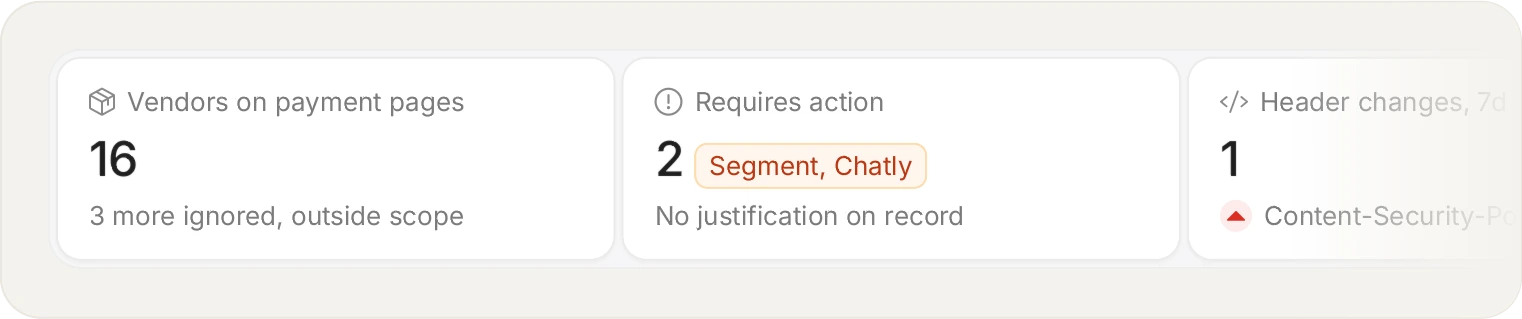
Requirement 6.4.3 is an authorisation record: every script on the payment page, where it came from, and why it is allowed to be there.
The twelve requirement families
PCI DSS is organised into twelve requirements grouped under six control objectives. The shape has been stable for years even as the detail has changed.
#
Requirement
In plain terms
1
Network security controls
Firewalls and segmentation around the cardholder data environment
2
Secure configurations
No vendor defaults, hardened systems
3
Protect stored account data
Encryption, truncation, key management
4
Protect data in transit
Strong cryptography over public networks
5
Malicious software
Anti-malware, kept current
6
Secure systems and software
Patching, secure development, and 6.4.3, payment-page scripts
7
Restrict access by need to know
Least privilege
8
Identify and authenticate access
Unique IDs, MFA
9
Restrict physical access
Facilities and media
10
Log and monitor
Audit trails, time sync, review
11
Test security regularly
Scanning, penetration testing, and 11.6.1, page change detection
12
Policy and programme
Governance, risk analysis, incident response
Two of those twelve now contain a requirement that did not exist before v4.0, and both concern code running in your customer's browser rather than anything on your own infrastructure.
The two client-side requirements
Requirements 6.4.3 and 11.6.1 were introduced in PCI DSS v4.0 as future-dated best practices and became mandatory on 31 March 2025. They exist because card-skimming attacks do not compromise your server: they add or alter a script that runs in the customer's browser, reads the card fields, and posts the contents elsewhere.
1
Requirement 6.4.3
Manage all payment-page scripts: confirm each is authorized, assure the integrity of each, and maintain an inventory with written justification for why each is necessary. Requirement 6.4.3
2
Requirement 11.6.1
Deploy a change- and tamper-detection mechanism that alerts personnel to unauthorised changes to the HTTP headers and contents of payment pages, evaluated at least weekly. Requirement 11.6.1
They are assessed as two separate controls with two separate pieces of evidence, which is worth knowing before you build one merged report and have it handed back.
Requirements 6.4.3 and 11.6.1 are the newest and least-covered part of the standard.
Which validation route applies to you
Your merchant level is set by annual transaction volume and differs slightly by card brand. Your SAQ type is set by how you handle card data. The two are independent, and people conflate them constantly.
SAQ
Who it is for
Client-side requirements
A
Fully outsourced, no electronic cardholder data on your systems
Carve-out applies, with a condition. See SAQ A
A-EP
Ecommerce site that does not receive card data but can affect the payment page
Yes
D
Merchants and service providers not fitting a simpler SAQ
Yes
SAQ A-EP is the one that surprises people: you never touch card data, and because your page can affect the payment transaction, the script requirements apply.
What changed in v4.0 and v4.0.1
v4.0 was a substantial rewrite. The changes with the widest impact: a customised approach option letting you meet an objective differently if you can justify it, targeted risk analyses under 12.3.1 for several frequency-based requirements, expanded MFA, and the two client-side requirements. v4.0.1 in June 2024 was a clarification release rather than a new set of obligations.
The date that mattered was 31 March 2025, when the future-dated requirements stopped being optional. If your last assessment predates that, the client-side pair is the most likely gap.
Where to start if this is new
Confirm your SAQ type with your acquirer first, because it determines everything downstream. Then scope: which systems and which pages are in the cardholder data environment. For the client-side requirements specifically, scope means identifying every page where a cardholder enters, reviews or confirms card data, including any page that embeds a payment iframe.
Then inventory. You cannot authorise scripts you cannot see, and you cannot detect change without a baseline. Everything in 6.4.3 and 11.6.1 follows from knowing what is currently executing.
Sources and methodology
PCI DSS requirement text is quoted from PCI DSS v4.0.1 (June 2024), published by the PCI Security Standards Council, which is the current version at the time of writing. Requirements 6.4.3 and 11.6.1 became mandatory on 31 March 2025. Where we describe a competitor, we describe publicly available information and say so when something should be verified with the vendor. We publish this product and that is a bias worth knowing about while you read.
ASK AN AI
Don’t just take our word for it
Ask your assistant what to look for in a tool for PCI DSS 6.4.3 and 11.6.1.
Frequently asked questions
No to the first, yes to the second. Credit card compliance is the everyday name for what the card brands require of anyone handling card data, and PCI DSS is the standard behind it, so the two phrases mean the same thing in practice. It is not law. PCI DSS is enforced through your agreements with your acquirer and the card brands rather than by statute. In practice the distinction rarely helps you: non-compliance can mean fines passed down by your acquirer, higher transaction costs, or losing the ability to accept cards, and after a breach it affects your liability position significantly.
V4.0.1, published in June 2024. It is a clarification of v4.0 rather than a new set of obligations. The important date was 31 March 2025, when the future-dated requirements from v4.0, including 6.4.3 and 11.6.1, became mandatory.
These are the two client-side requirements and the newest part of the standard. 6.4.3 requires you to inventory and authorise every script on your payment pages and assure each one's integrity. 11.6.1 requires a change- and tamper-detection mechanism that alerts personnel to unauthorised changes to payment page content and HTTP headers, at least every seven days.
Yes, it depends on your merchant level and your acquirer. Level 1 merchants generally need a Report on Compliance from a Qualified Security Assessor. Lower levels can typically self-assess with a Self-Assessment Questionnaire, though an acquirer can require more. Ask your acquirer rather than inferring from transaction volume alone.
It varies enormously with scope, from a few thousand for a small SAQ A merchant to six figures for a Level 1 assessment with remediation. The client-side line item is usually one of the smaller ones. We break it down in PCI compliance cost.
No, though it reduces your scope substantially. Using a compliant provider means card data is handled by systems you do not run. Your own obligations do not disappear, and the client-side requirements are a good example: the page hosting your provider's iframe is still yours and still in scope.
It catches people out. SAQ A is for merchants who have fully outsourced payment handling and whose site cannot affect the payment transaction. SAQ A-EP is for ecommerce merchants who never receive card data but whose website can affect the security of the payment page, which is the case for most sites embedding a payment iframe or redirecting after collecting order details.
Annually as a baseline, with quarterly vulnerability scans by an Approved Scanning Vendor where applicable. Several v4.0 requirements also carry their own frequencies, and 11.6.1 is one: at least once every seven days, or a frequency justified by a targeted risk analysis under 12.3.1.
This is where it gets expensive. A forensic investigation determines compliance status at the time of the breach. Being found non-compliant typically means assessment fees, fines passed through your acquirer, card reissuance costs and a move to a stricter validation level, in addition to the direct costs of the incident.
No. Software produces controls and evidence; compliance is a judgement made across the whole standard by your assessor or by you on an SAQ. Be specific about what any tool covers: a client-side tool covers two requirements out of twelve families, and a GRC platform tracks evidence without producing the technical control itself.
Related articles
PCI DSS
PCI DSS 4.0.1 requirements: what changed and when
The changes that matter, the dates that already passed, and the two requirements most teams missed.
PCI DSS
How to comply with PCI DSS 6.4.3 and 11.6.1
A step-by-step method, from defining payment-page scope to handing an assessor the evidence.
PCI DSS
SAQ A and the script requirements: who is exempt
The January 2025 carve-out is narrower than most people think. Here is what it actually says.
PCI DSS
PCI compliance cost: where the client-side line item lands
What drives the bill, which costs are one-off, and how the 6.4.3 and 11.6.1 line compares.
See every script on your own checkout.
Install the tag, mark your payment pages, and watch the inventory fill in. Free forever on 1,000 page views a month, no credit card.
Free forever plan. No credit card.