PCI DSS 4.0.1
PCI DSS requirement 11.6.1, in plain terms
Detect unauthorised changes to your payment pages and their HTTP headers as the customer's browser received them, alert a human, and keep the record. Here is what 11.6.1 asks for.
Start for free
Talk to an expert
TL;DR
PCI DSS 11.6.1
WHAT IT REQUIRES
A change- and tamper-detection mechanism that alerts personnel to unauthorised changes to the HTTP headers and contents of payment pages as received by the consumer browser, evaluated at least once every seven days.
THE DELIVERABLE IS THE ALERT
Detection alone is half the control. The evidence is the record that a change was found and that a named human was told about it.
SEVEN DAYS IS A FLOOR
An attack that runs for six days sits comfortably inside a weekly window. Continuous evaluation removes the question entirely.
Short on time? The cleanest evidence is a weekly record of every distinct value observed per security header, plus the alerts raised.
ON THIS PAGE
What is PCI DSS requirement 11.6.1?
PCI DSS 11.6.1 requires a change- and tamper-detection mechanism that alerts personnel to unauthorised modification of the HTTP headers and the contents of payment pages as received by the consumer browser, and that performs this evaluation at least once every seven days. It is the detection half of the client-side pair introduced in PCI DSS v4.0 and mandatory since 31 March 2025. Requirement 6.4.3 establishes what is supposed to be on the page. 11.6.1 notices when reality stops matching that. They are assessed as two separate controls with two separate pieces of evidence, which is why keeping them in one merged report is a common reason evidence gets sent back.
What requirement 11.6.1 actually says
11.6.1 asks you to deploy a change- and tamper-detection mechanism, and it is specific about what that mechanism has to do:
01
Alert personnel to unauthorised modification
Including indicators of compromise, changes, additions and deletions, to the HTTP headers and the contents of payment pages. The alert is the deliverable. A dashboard nobody opened is not an alert.
02
Evaluate the received header and page
As received by the consumer browser. Not as your server intended to send it, and not as a crawler in a datacentre received it. What the customer's browser got is the thing under assessment.
03
Run at least once every seven days
Or at a frequency defined by a targeted risk analysis performed under requirement 12.3.1. Seven days is the default, and continuous monitoring comfortably satisfies it.
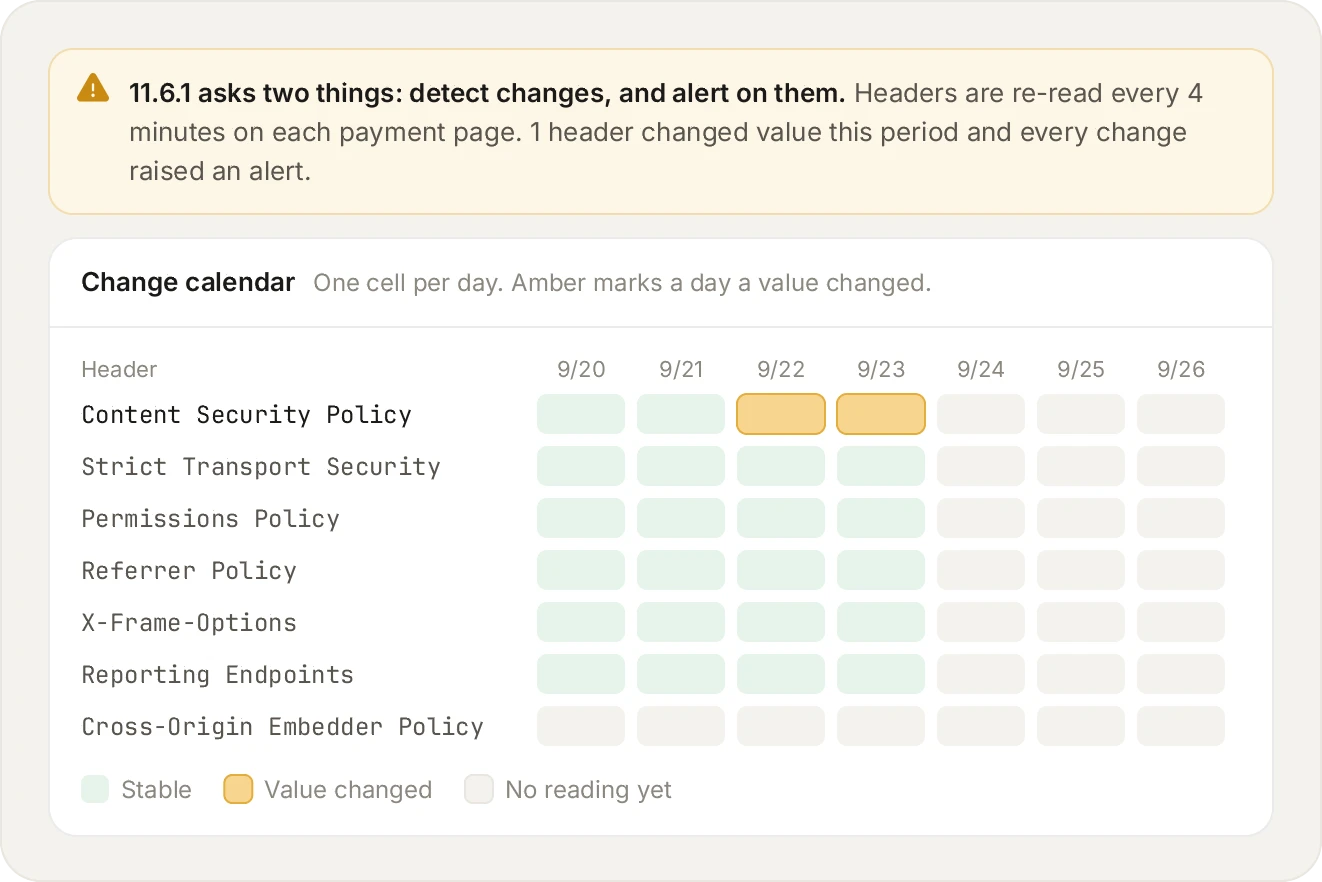
Requirement 11.6.1 is a change-detection record. Two distinct values for one header inside the weekly window is the change, and the alert is the evidence that personnel were told.
Tamper detection on a page you do not fully control
A payment page is assembled at runtime from parts you own and parts you rent. Tamper detection has to cope with that: the page legitimately differs between visitors, because of A/B tests, locale, consent state and logged-in status. A mechanism that alerts on every difference is noise, and a mechanism tuned until it is quiet has usually been tuned past the point of usefulness.
The workable distinction is between the page varying and the page changing. A new script origin, a changed payload hash on an approved script, a security header taking a value it has never taken before, a new outbound destination: those are changes. A different hero image for half your traffic is variance. The evidence an assessor wants is the first category, recorded with timestamps and a record of who was told.
Why HTTP headers are named explicitly
Headers are in the requirement because weakening one is a quiet way to make an attack possible. Loosening a Content-Security-Policy, dropping X-Frame-Options, or removing HSTS changes what the browser will permit, and none of it is visible in the page body. A header change is often the first observable step of an attack rather than the attack itself.
The practical output is a weekly record of every distinct value observed per header. One value across the window means the header was stable. Two values means something changed, and the record shows what it changed to and when, which is exactly the evidence 11.6.1 is asking you to keep.
Header monitoring and page tamper detection are on every plan, including the free one.
Start for free
See pricing
PCI 11.6.1 and what "at least once every seven days" means
You will see this written as both PCI 11.6.1 and PCI DSS 11.6.1, and they refer to the same requirement. Seven days is a floor, not a target. An attack that runs for six days inside a weekly window is fully compliant and fully successful. The requirement allows a different frequency if you justify it through a targeted risk analysis under 12.3.1, but that is paperwork to run slower, and almost nobody wants that argument with an assessor.
Continuous monitoring removes the question. If the mechanism evaluates every session, the seven-day floor is met by a wide margin and the evidence pack can state the actual frequency instead of the minimum.
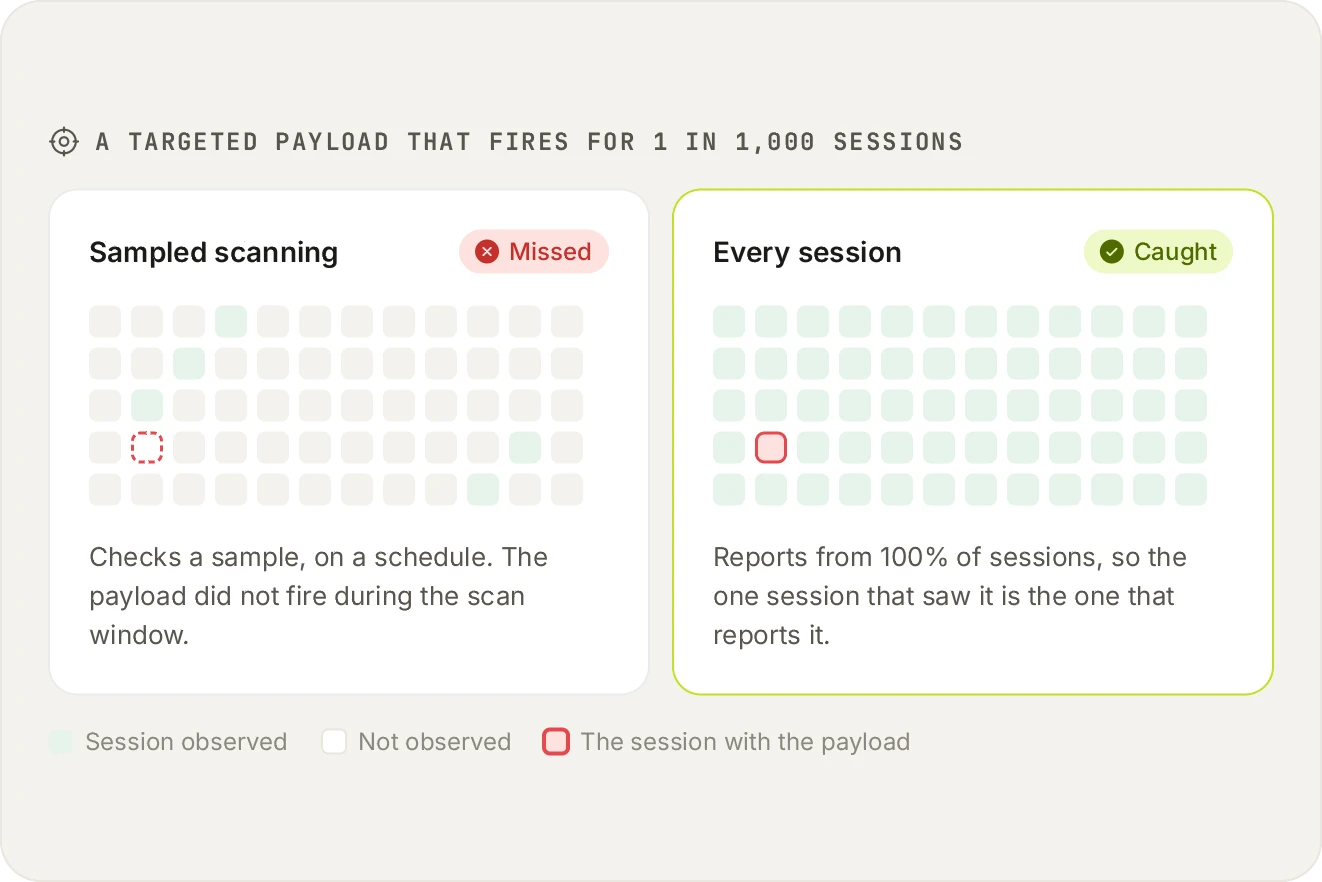
A targeted skimmer fires for a slice of traffic: one country, one card BIN, one hour. Sampling is the norm in this category, commonly 10% of sessions and sometimes as low as 1%. That is a coin flip against an attack designed to be rare.
The evidence an assessor asks for
For 11.6.1 specifically: the list of pages in scope, the headers and page properties being evaluated, the frequency, the record of changes detected in the period, and proof that personnel were alerted. That last one is the one teams forget. Detection without a recorded alert is half the control.
Frequently asked questions
Read the FAQ
Yes, and it is a known evasion rather than a theoretical one. A scheduled scan arrives from a datacentre address with no session, no cart and no consent state, which makes it an identifiable visitor. A payload written to behave for that visitor and misbehave for a real one produces a clean scan and a compromised checkout at the same time.
No, and that is the point. A compensating control has to exceed the requirement it replaces, which is a higher bar and a longer conversation with your assessor. This meets 6.4.3 and 11.6.1 directly, so there is no compensating-control argument to make.
No, seven days is the stated minimum, with the option to justify a different frequency through a targeted risk analysis under requirement 12.3.1. Continuous evaluation is simply the easiest way to satisfy it, because you never have to argue about the interval and the evidence can state the real frequency rather than the floor.
The security-relevant ones are what matter: Content-Security-Policy, X-Frame-Options, Strict-Transport-Security, X-Content-Type-Options and similar headers that change what the browser permits. The requirement says the HTTP headers of the payment page, so the practical approach is to record every distinct value observed per header and let the record show which ones moved.
Sometimes, and it depends on your assessor. The requirement says the page as received by the consumer browser, and a scanner receives the page as a datacentre IP with no session, no consent state and no logged-in user. That is a different page from the one your customers get. Some assessors accept scanning, and some do not accept a control that cannot block, so confirm this early rather than after you have bought something.
This needs a definition you can defend: a new script origin, a changed payload hash on an approved script, a security header taking a value it has not taken before, or a new outbound destination. Page content that varies by test, locale or consent state is variance rather than change, and a mechanism that cannot tell the two apart produces noise nobody reads.
Yes, a person. The requirement says alert personnel. A log that nobody is subscribed to does not meet it, and the alert record is the part an assessor asks to see. There are three channels: email, a webhook to any destination you like, or an S3 bucket. All three work, provided a human is genuinely on the other end.
They are different controls. 6.4.3 is an authorisation record: what is allowed on the page and why. 11.6.1 is a change-detection record: what actually changed and who was told. One is a list, the other is a record of what changed, and an assessor will ask about them separately.
Start with the scripts already on your checkout.
Install the tag, mark your payment pages, and see the inventory fill in. Free forever on 1,000 page views a month, no credit card.
Free forever plan. No credit card.