Script monitoring for ticketing and event checkout pages
Ticketing is where client-side attacks became a boardroom subject. The checkout is short, the traffic is spiky, and the page is usually carrying chat, affiliate and analytics code from suppliers nobody on the team has met.
Start for free
Talk to an expert
TL;DR
Ticketing and events and the client-side requirements
THE OBLIGATION
PCI DSS 6.4.3 and 11.6.1 have been mandatory since 31 March 2025 for any page where a cardholder enters, reviews or confirms card data.
THE SPECIFIC DIFFICULTY HERE
Onsale spikes are exactly when nobody wants to touch the checkout, and exactly when a skimmer collects the most cards per hour.
WHAT THE TAG PRODUCES
A script inventory with justifications, a weekly header change record, runtime blocking, and an evidence pack for your assessor.
Short on time? The canonical breach in this sector arrived through a third-party chat supplier.
What is Magecart
Does ticketing and events need PCI DSS script monitoring?
Yes, if you operate any page where a cardholder enters, reviews or confirms card data, which includes pages that embed a payment iframe. Ticketing is where client-side attacks became a boardroom subject. The checkout is short, the traffic is spiky, and the page is usually carrying chat, affiliate and analytics code from suppliers nobody on the team has met. Requirements 6.4.3 and 11.6.1 apply to those pages regardless of platform, and have done since 31 March 2025.
Where the exposure is
Onsale spikes are exactly when nobody wants to touch the checkout, and exactly when a skimmer collects the most cards per hour
Support chat, seat maps, affiliate tracking and promoter pixels all load on the page where the card is typed, often through a tag manager
A supplier’s own code is the documented entry point: in the 2018 Ticketmaster breach a customised JavaScript file from a third-party chat supplier was altered and ran on the payment page
Promoters and venues bring their own tags as a contractual condition, and those tags arrive after your last review
What the inventory shows you
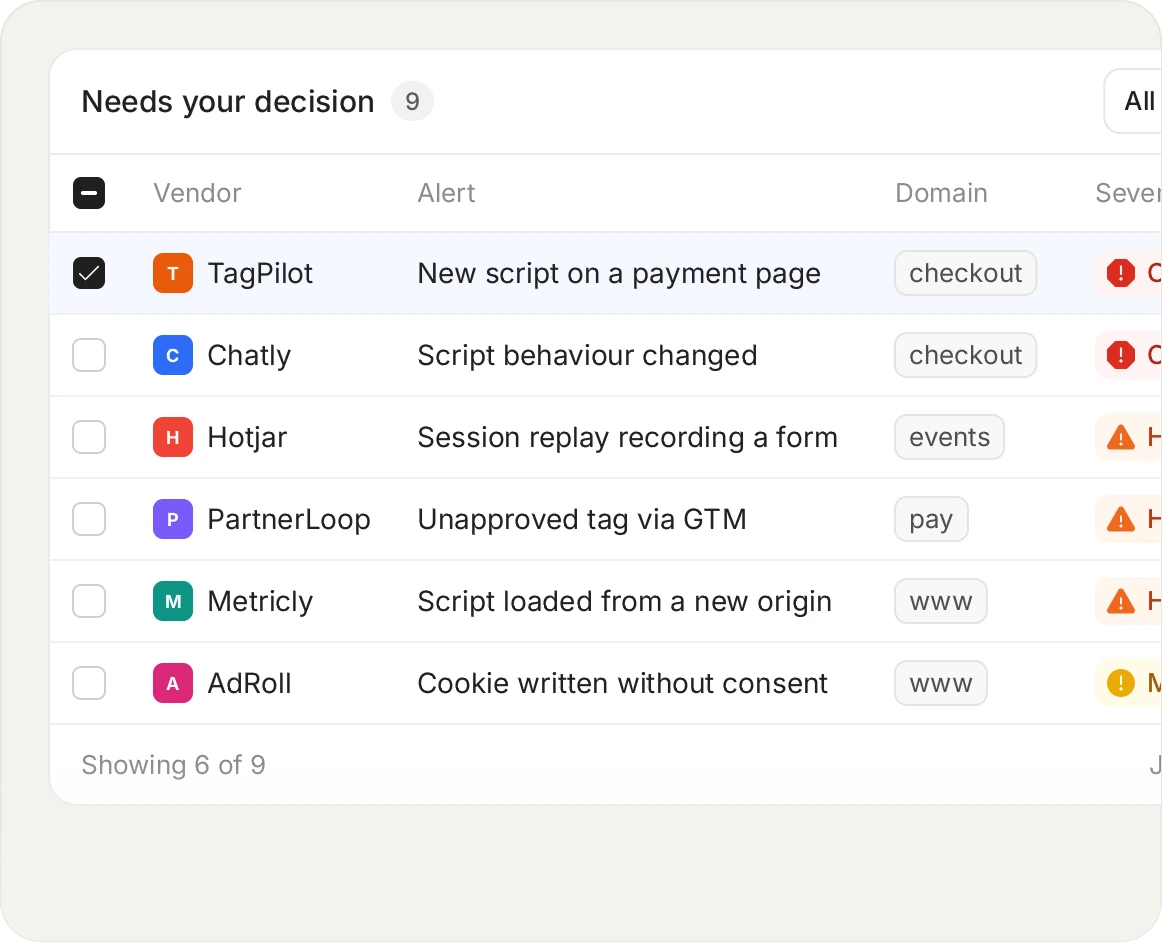
Every script on basket, checkout and confirmation, including tags added by a promoter or venue
A supplier shipping changed code, caught by payload hash, which is the exact shape of the Ticketmaster and Inbenta case
Scripts reading payment fields when their stated purpose is seat selection or support
Tag manager publishes that add a script to checkout without a change ticket
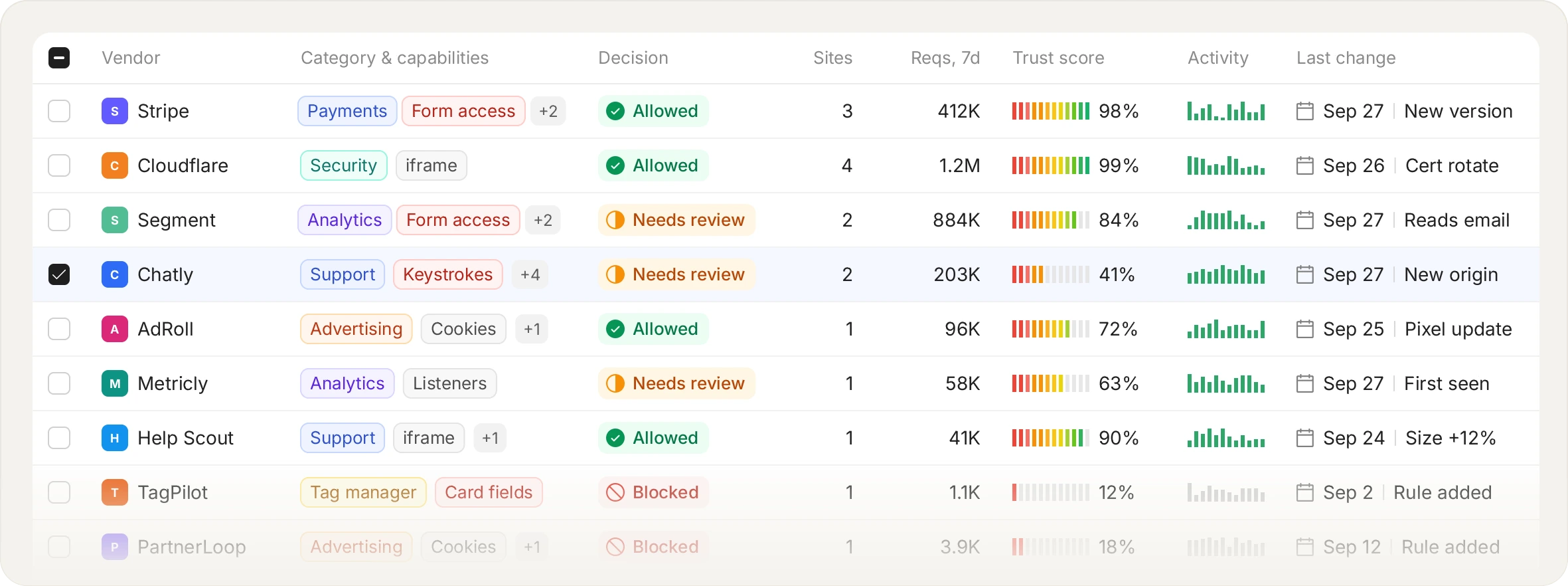
Requirement 6.4.3 is an authorisation record: every script on the payment page, where it came from, and why it is allowed to be there.
The two requirements, in this context
Frequently asked questions
Read the FAQ
It is the canonical case and worth knowing precisely. In 2018 a customised JavaScript file supplied by Inbenta, a third-party chat supplier, was altered and served on Ticketmaster payment pages, capturing card data. Ticketmaster did not write the code and it was not on Ticketmaster infrastructure, which is the point: 6.4.3 exists because a page you own can execute code you did not write and cannot see change.
Yes, and continuous monitoring fits it better than scheduled scanning does. 11.6.1 asks for change detection at least every seven days, but a scan run on a Tuesday tells you nothing about a Friday onsale. Reporting from real sessions means the traffic you actually had is the traffic you have evidence for.
Yes. The tag is small, asynchronous and fail-open, so if our service is unreachable your checkout still completes. We are a monitoring dependency, never an availability dependency.
Yes, and this is the common case. Authorise the tag, record the justification and who required it, then block the single capability you are not willing to grant, such as reading form fields. The tag keeps working and the contractual obligation is met.
No. Domains are unlimited on every plan, and teams let you keep each client’s scope, alerting and evidence separate under one organisation.
No, not the page around it. The iframe is your provider’s, the page hosting it is yours, and an overlay drawn on top of an iframe collects cards perfectly well.
A generated pack: scope with the selector rules that matched each page, the script inventory with a justification per script, every security-header change with timestamps, and the alerts raised and acknowledged.
No, and we would rather say so. This covers script integrity and the two client-side PCI requirements. Scalping is a bot management problem and needs a different tool.
See the scripts on your own payment pages.
Free forever on 1,000 page views a month, no credit card. Unlimited domains on every plan.
Free forever plan. No credit card.