How it works, and what it does not do
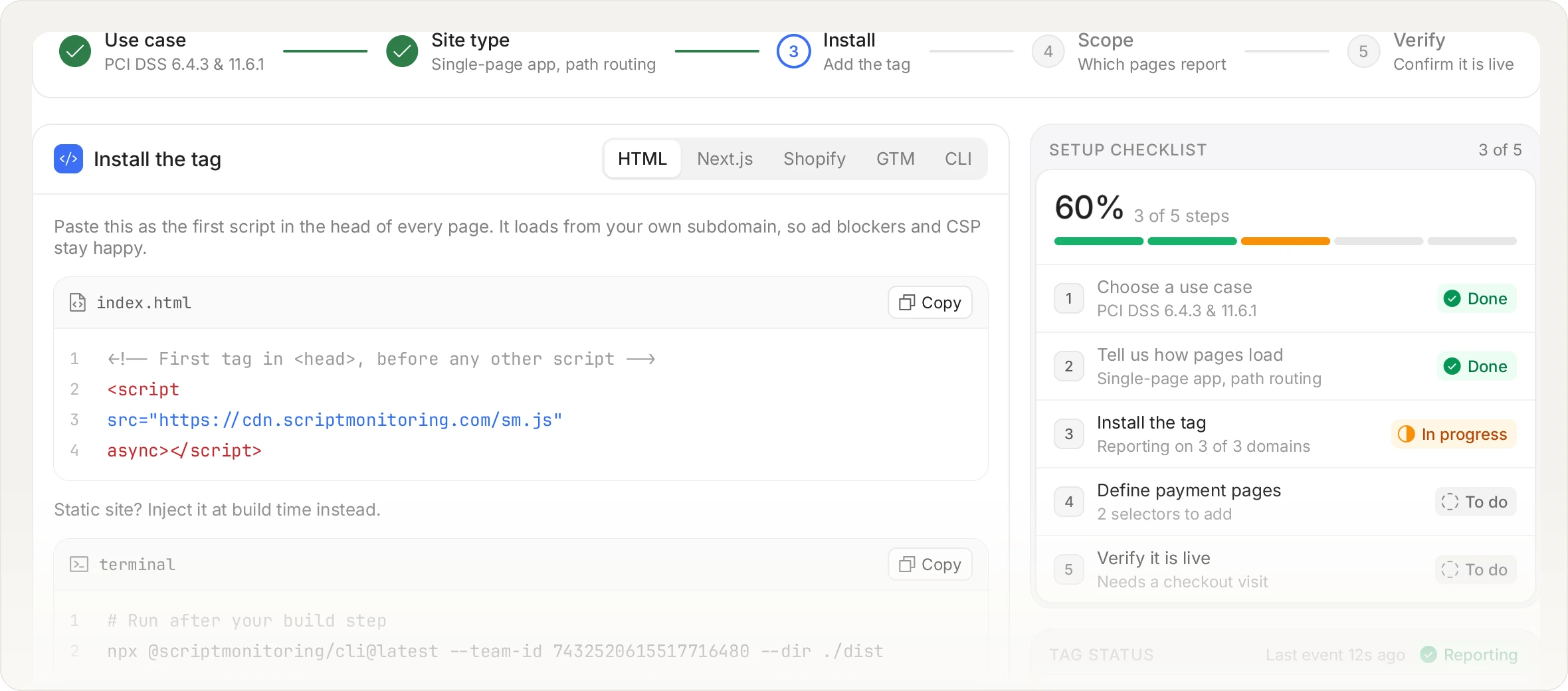
One first-party tag reports what scripts do in the live session. The scripts themselves are fetched from our side to be hashed, archived and analysed. Your traffic is never routed anywhere.
Start for free
Talk to an expert
What is how it works?
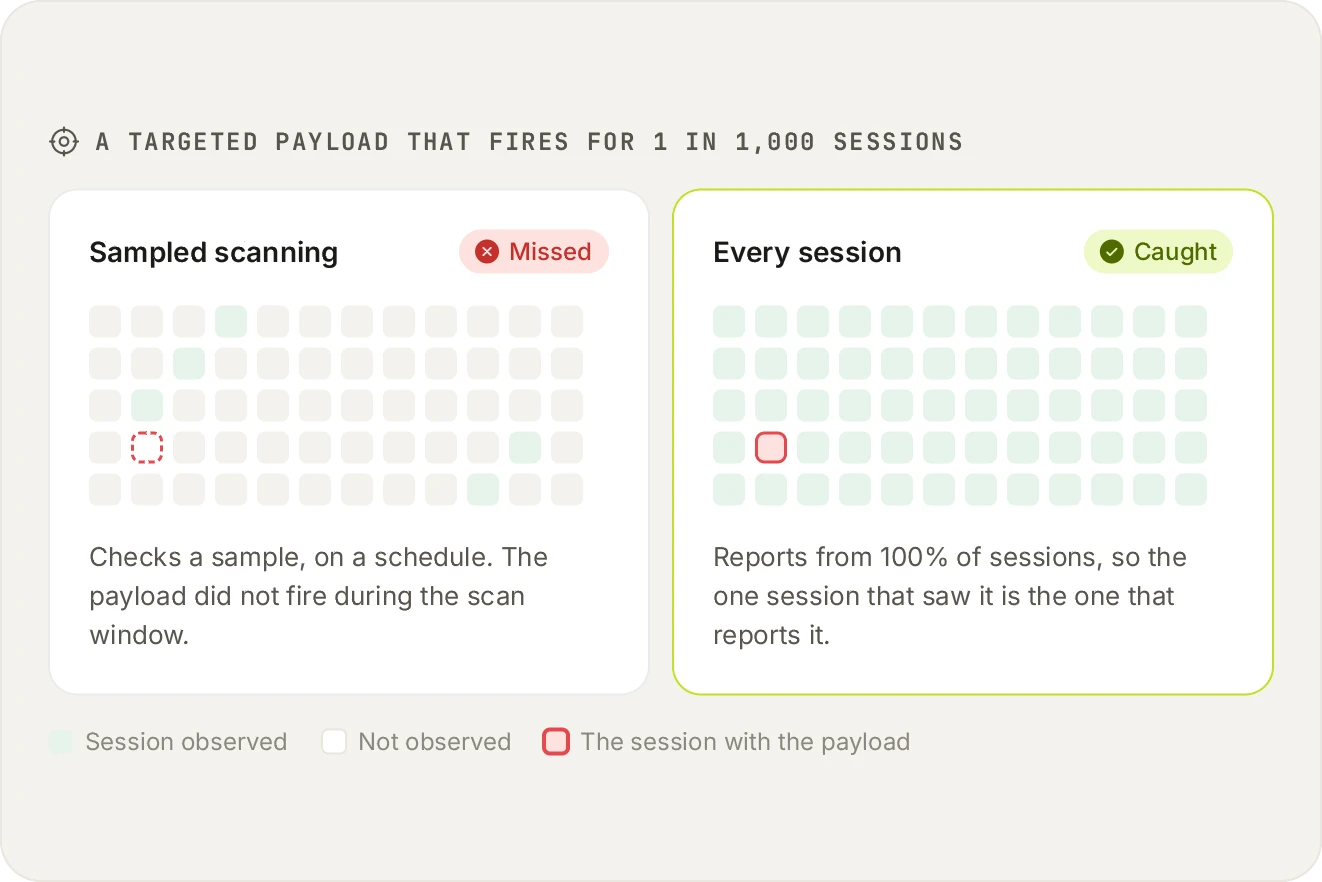
A first-party tag on your page records what each script does at runtime, and each third-party script is separately fetched by us, hashed, archived and analysed off the page. The split matters. Doing deep analysis in the visitor's browser would be slow and easy to observe. Doing everything off the page would miss what a script actually did in a real session. Running both means a recorded behaviour can be tied to the content hash of the specific script that produced it, which is what makes the evidence hold up.
What the tag does in the page
Records behaviour across classes that matter: form-field access, permission requests, network requests, storage access, key event listeners and DOM manipulation. Each recorded behaviour carries a call-stack trace naming the script URL, its content hash, and the line and column.
What happens off the page
Each third-party script is fetched from our infrastructure so it can be hashed, archived and de-obfuscated without spending your visitor's CPU. The archive is what lets you diff a payload against the version you approved, and what gives you the actual code after an incident.
The tag verifies itself
The monitoring script is integrity-checked when it loads. If the file that arrives in the browser is not the one we published, it does not execute. This is the part that is easy to overlook when evaluating client-side security: an agent an attacker can quietly alter is worse than no agent, because it goes on reporting a clean page while the checkout is being skimmed. Ask any vendor whether their agent verifies itself on load.
What it deliberately does not do
It does not route your site traffic. There is no DNS change and no CDN change, and we are not a dependency for your site being reachable: the tag is fail-open, so if our service is unavailable your page still renders and your checkout still works. It also does not store user-entered values. The subject of monitoring is the script, not the visitor.
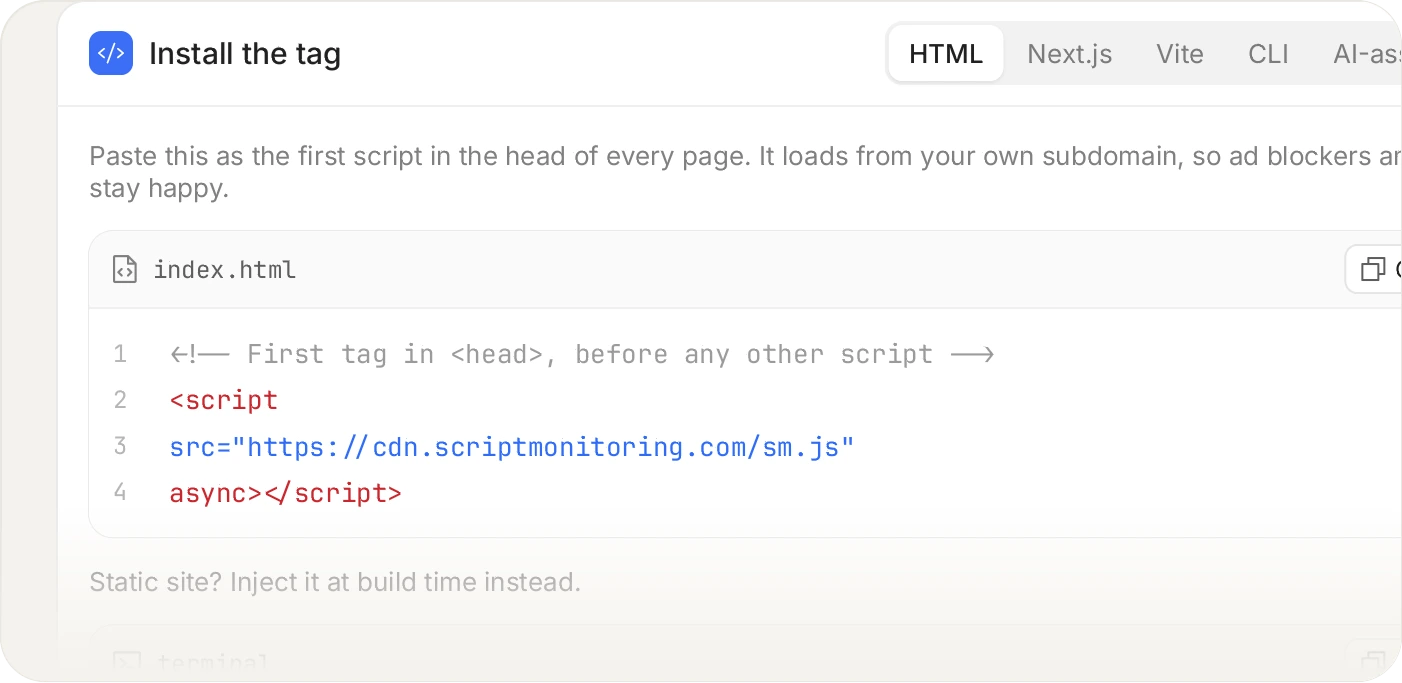
One first-party tag, added the way your stack already ships code. No DNS change and no CDN change, because your traffic is never routed anywhere.
Related platform capabilities
Script inventory
Every script, with a justification per script.
Tamper detection
Content and integrity changes on the page.
Header monitoring
Distinct values seen per header, per week.
Vendors and load chains
Who loaded whom, and from where.
Script blocking
By URL, hash, domain, or single action.
Monitor-only mode
The same evidence, nothing stopped.
Frequently asked questions
Read the FAQ
Yes. The tag is integrity-checked on load, so if the file delivered to the browser is not the one we published it does not run. A monitor that can be silently modified reports all-clear while the page is compromised, which is the worst possible failure mode for this class of product.
No. There is no DNS change and no CDN change, and your site traffic never passes through us. The tag runs on your page and reports. Separately, we fetch the third-party scripts themselves so the heavy analysis happens on our side rather than in your customer's browser.
No, and this is a deliberate boundary. The subject of monitoring is the script: which scripts ran, what they were, what they touched and where they sent data. We do not store user-entered values such as card numbers, passwords or form contents.
This is the right question to ask of anything on a checkout. The tag is fail-open by design: if it cannot reach us, your page renders and your checkout completes normally. You lose monitoring for that period, and you do not lose your checkout. Enterprise plans carry a 99.9% uptime SLA.
Partly, and we would rather be precise than boastful here. The in-page engine is a first-party script and is visible in the page like any client-side product, so a determined attacker can study it. What is harder to defeat quietly is the record it leaves: each behaviour is tied to the content hash of the script that ran, a range of detections run off the page against our own fetched copy, and an anti-tamper package makes the in-page detections materially harder to manipulate. A script that behaves differently when it thinks it is watched still leaves a content-hash artefact and a version diff.
See it on your own payment pages.
Install the tag, mark your payment pages, and watch the inventory fill in. Free forever on 1,000 page views a month, no credit card.
Free forever plan. No credit card.